Roleplay6 min read
FiveM police roleplay: how to run a police department
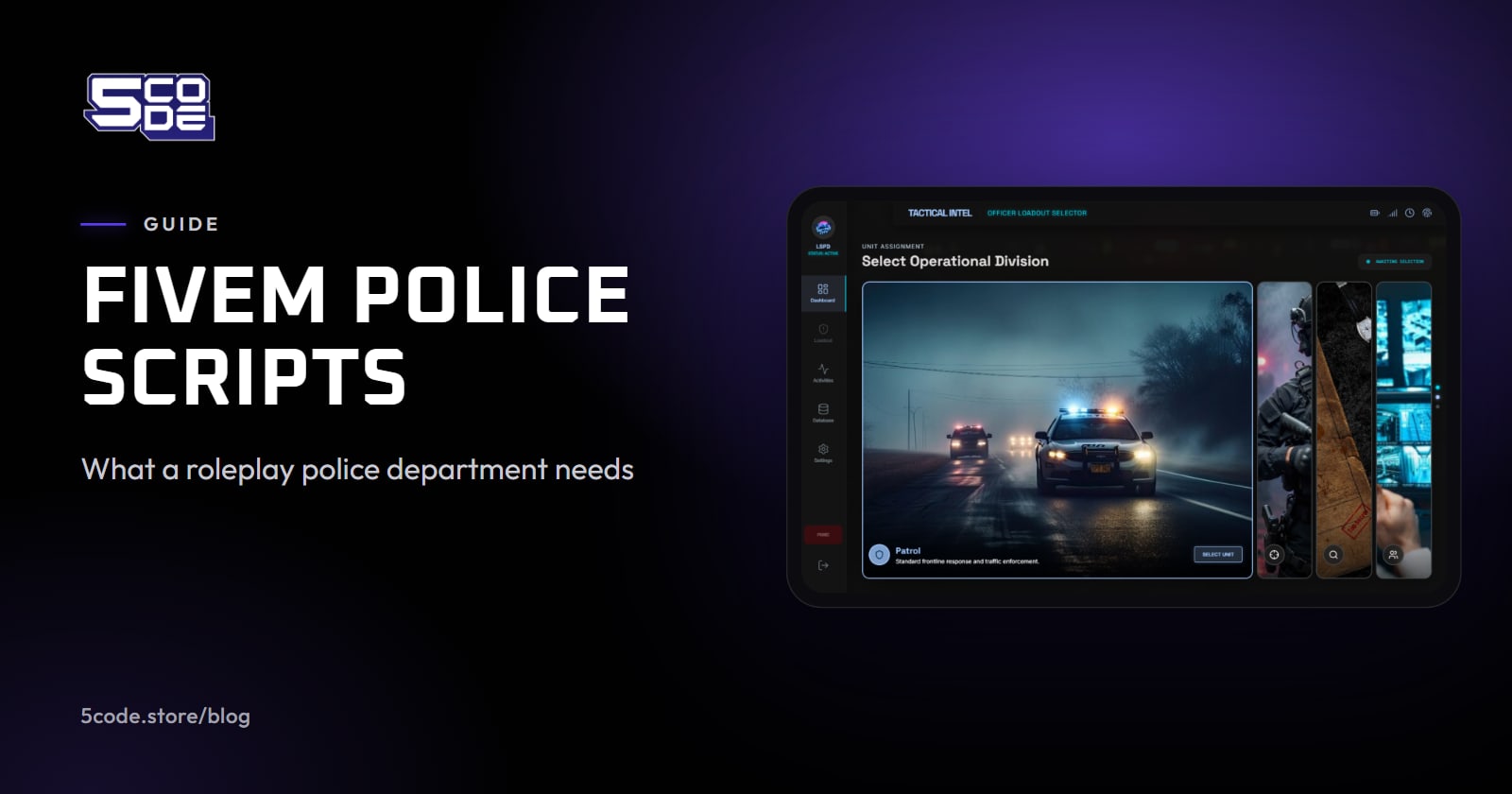
Running police on a roleplay server is mostly organization: who gets in, and which rules both sides of a scene follow. This guide, for owners and command staff, goes through it with rules that real servers publish.
Patrick MiddlemanPublisher at 5CODE
- Published
- Last updated
On this page7
The short version
FiveM police roleplay works when the department is run as a small organization, with ranks and a written SOP that every recruit trains on, and when the server's rules keep officers and criminals on even terms. Command decides who wears the badge and how they behave. Staff decide whether a scene was fair.
Department structure: ranks, units and command
The stock police jobs give you the bottom of the ladder: five grades from Recruit to Chief, with Chief as the boss grade. Qbox also ships BCSO and SASP as separate jobs.
Start small. Older advice on the Cfx forum (opens in a new tab), from 2017, recommends one or two departments at first, and few sub-divisions: a SWAT call answered by the only SWAT officer on duty goes badly. Add a unit when you have the officers to staff it, and keep a roster of who belongs where.
Two points save trouble later:
- Ranks have to match what the server enforces. Scripts read the framework grade, not the title in your Discord. If your ladder has more ranks than the job has grades, add grades, or map several titles to one grade on purpose.
- Command is not staff. The chief runs the department in character, and admins enforce server rules out of character. When one person holds both roles, another staff member takes rule cases about their department. Torrid Roleplay's rules (opens in a new tab) make staff step aside from any ticket involving their own character, friends, group members or scenes they were part of.
Recruitment and training: from application to solo patrol
Servers that whitelist police put them behind an application. A typical path, from public department pages:
- Application and interview. DPSRP states (opens in a new tab) that "All emergency services on DPSRP are whitelisted"; its command staff review each application and may invite the applicant to a brief interview.
- Police academy. Classroom time on the SOP, the penal code, radio procedure and the server's police rules. Green Bear (opens in a new tab) allows training only on its training server.
- FTO program: ride-alongs with a field training officer. The San Andreas State Police FTO handbook (opens in a new tab) keeps the recruit in the passenger seat for the first two or three ride-alongs, and says: "The goal is NOT to train a recruit quickly."
- Sign-off, then solo patrol. The same handbook has a proficiency checklist covering the MDT, radio procedure, traffic and felony stops, the penal code and use of force. An item is checked off only once the recruit proves it in the field.
FiveM police roleplay rules for officers and civilians
An SOP is the department's own rulebook. The San Andreas State Police site linked above keeps separate pages for its uniform, vehicle, use of force and pursuit policies.
The server rules cover both sides of a police scene. The terms below come from the published rules of Green Bear Network (opens in a new tab) and Torrid Roleplay (opens in a new tab); your own rules set the exact wording.
| Term | Meaning | Source |
|---|---|---|
| Cop baiting | Acting only to draw police into a chase or a confrontation | Green Bear 4.3, Torrid |
| Escalation | No instant tasing or shooting without escalation first | Green Bear 4.7 |
| Reason to flee | Running needs an RP reason; fleeing without cause is FailRP | Torrid |
| Clean escape | Two full minutes with no police visual contact | Torrid |
| Backup limit | At most two extra criminals join a chase | Torrid |
| Minimum police | Some robberies need a set number of officers on duty | Torrid |
| Priority cooldown | No major crime until the last one's cooldown expires | Green Bear 1.23 |
| Combat logging | Leaving the game to escape a scene or an arrest | Green Bear 1.9, Torrid |
| Corrupt cop | An officer roleplaying corruption | Green Bear 4.8 (only with staff permission) |
Corruption needs its own written answer. Green Bear allows it only when a staff member who may permit it says yes; your rules should say whether it is allowed at all, and who may approve it.
Fair play: police should not win every scene
In FiveM police roleplay, a department with the radio and the numbers can end every scene in its favor, which leaves criminal players little to play for. Published rules show the levers servers use:
- Minimum police on duty. Torrid needs three officers on duty for a Pacific Bank robbery and two for Ammu-Nation.
- A backup limit. Torrid caps criminal backup in a chase at two.
- A way for the chase to end. Torrid counts two minutes without visual contact as an escape, and says "violence should never be the primary objective."
- A cooldown. Green Bear's priority cooldown "allows LEOs to reset and keeps RP balanced."
When a civilian thinks a scene was unfair, the answer is a staff report after the scene; Green Bear says "All major disputes should be handled via staff reports, not in chat."
Gear and radio: accountability and police metagaming
Issued gear needs rules on both sides of the badge. Officers should carry only the kit their rank and unit allow. Outside its air-drop events, Torrid's robbery policy lets players take only a body camera and a GPS from an officer. Command still needs to know who took what.
The police radio needs its own metagaming rule. SADRP's meta gaming rules (opens in a new tab) treat "All law enforcement radio communications" as encrypted, and staying clocked in on a police character to monitor police while playing another one counts as metagaming there. Green Bear bans police scanners and keeps its radio channels to police and EMS. On pma-voice, the server can add a channel check (opens in a new tab) that decides who may join a radio channel, for example by an ACE permission.
Players with both a police and a criminal character are the other risk. Torrid asks them to tell staff in a ticket, and nothing learned on one character may be used by the other. What metagaming is and how staff judge a report covers the general rule.
Keeping count with 5CODE Loadouts
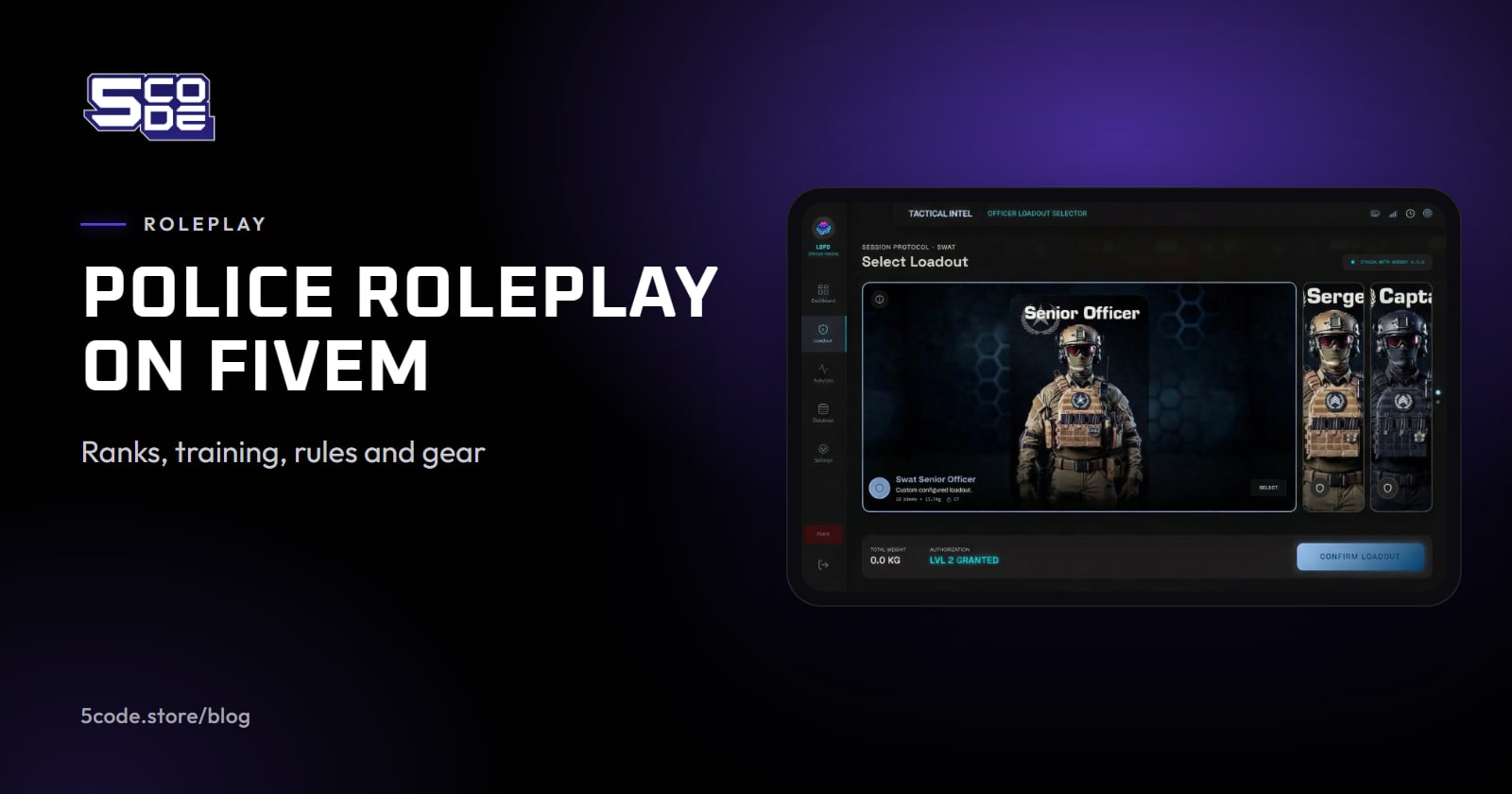
5CODE Loadouts is a police armory that keeps count. Officers take a pre-built loadout for their unit at an armory NPC; a deposit leaves their bank on deploy and comes back on return, minus a penalty for anything missing.
- One kit per officer. No second loadout until the first one is returned at the armory.
- A log-off does not close the deployment. It stays open, and Command is notified on Discord.
- A record for command. Every action is logged in game and to Discord, and the activity log can be searched by officer, badge or citizen id.


It has limits. Whether a missing pistol was lost in a fight or sold stays a question for command. Loadouts serves one job: only players in that job can use the armory, so on Qbox, officers in the separate BCSO and SASP jobs cannot use an armory set up for the police job. It hands out only items already registered in your inventory, and it supports QBCore, Qbox and ESX. How to set up police loadouts per unit covers the setup.
Where to go next
Start with the table above: settle each term in your own rules, then build the SOP and the FTO checklist that teach it. If you want the armory to keep its own record of who took what, the docs explain how deposits and returns keep officers accountable.